Key Takeaways (TL;DR)
- If your voltage regularly dips below 140V, a double booster might be your only option. Here's the full breakdown.
- Protect Your Investment: Voltage stabilizers prevent silent damage to expensive PCBs and compressors.
- Expert Engineering: VoltUp products are ISO 9001:2015 certified and engineered for Indian power conditions.
You're at the electronics store buying an AC stabilizer. The salesman asks, "Sir, do you want a single booster or a double booster?" and you freeze. What is a double booster, and why does it cost ₹2,000 more?
This guide explains the "double booster" concept, how it differs from standard stabilizers, and exactly who needs one (and who is just wasting money).
What Exactly is a Double Booster?
Every stabilizer has a transformer inside with different physical "tappings" (connection points) that allow it to increase or decrease voltage.
- Standard (Single Booster): Designed to handle typical fluctuations. It usually operates in the 150V to 280V or 170V to 270V range. If voltage drops to 150V, it can boost it up to a safe ~220V.
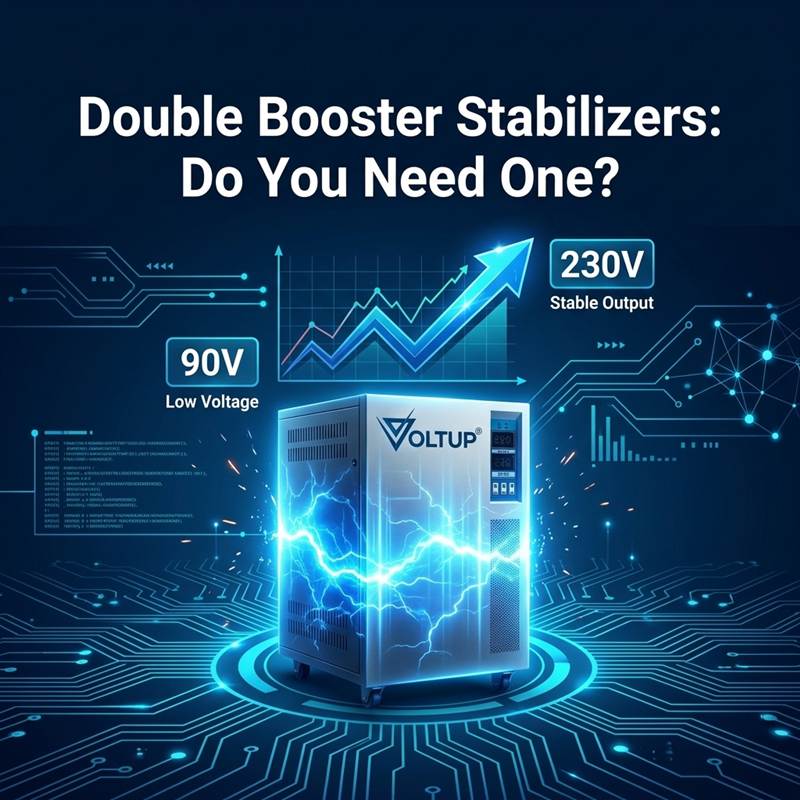
- Double Booster: Designed for extreme conditions. It has additional winding capacity (essentially a second stage of boosting). It operates in a much wider range, typically 90V to 300V or 110V to 280V. If voltage drops to an abysmal 90V, it can double boost it back up to a working voltage.
How It Saves Your Appliances in Extreme Conditions
Imagine your grid voltage drops to 120V during peak summer evening hours in a rural area or outskirts of a city.
| Device | Action at 120V Grid Input | Result for AC |
|---|---|---|
| No Stabilizer | Fails completely | Compressor tries to start and burns out. |
| Single Booster (Range: 150V-280V) | Triggers "Low Cut" feature | AC turns off completely to stay safe. (You sweat). |
| Double Booster (Range: 90V-300V) | Engages second boost stage | Outputs ~200V. AC runs perfectly. (You sleep comfortably). |
Do YOU Actually Need One? (The 3-Step Test)
Don't just buy a double booster blindly because "more is better." They are heavier, bulkier, more expensive, and consume slightly more idle power. Take this test:
Buy a Double Booster IF:
- ✔ You live in a rural area, a developing suburb, or at the very end of a long distribution line.
- ✔ Your lights become visibly very dim (almost yellow/orange) during summer evenings.
- ✔ An electrician has measured your evening voltage and found it drops below 140V.
Stick to a Standard (Single Booster) IF:
- ✖ You live in a metro city proper (Tier 1) where major drops below 170V are rare.
- ✖ Your building uses a large central servo stabilizer for the whole society.
- ✖ You just need protection against occasional spikes, not chronic low voltage.
Buying Tips for Double Boosters
- Copper is Mandatory: Because double boosters generate more heat when boosting from very low voltages (like 90V), 100% copper winding is absolutely critical. Aluminium will overheat and fail quickly in these conditions.
- Check the Specs, Not the Sales Pitch: Ignore the marketing name ("Double Booster", "Super Booster"). Look strictly at the Input Voltage Range printed on the box. If it says "90V - 300V" or "130V - 280V", that gives you the true capability.
- Derating Factor: Be aware that at 90V, a 4 KVA stabilizer cannot deliver a full 4 KVA of output (due to transformer physics). Always buy a slightly higher capacity (like 5 KVA for a 1.5-ton AC) if you expect to operate continuously at 90V.
Table of Contents
Need a Stabilizer?
VoltUp engineers are directly available to help you find the absolute perfect voltage stabilizer for your home appliances.
Contact Us Today