Key Takeaways (TL;DR)
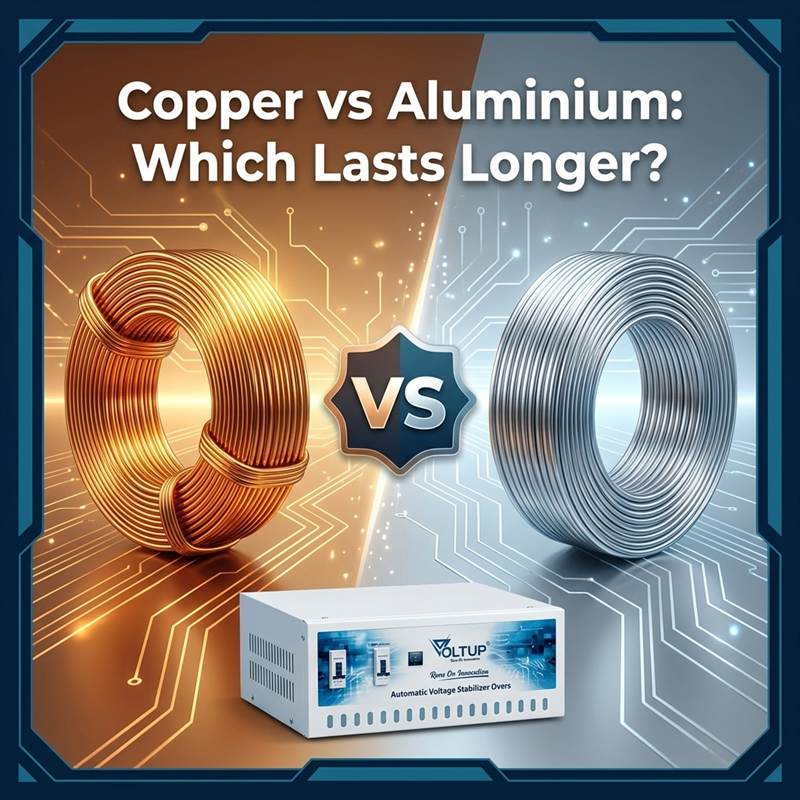
- Copper vs aluminium winding stabilizers: which lasts longer, saves energy, and protects appliances best? A detailed comparison with data for Indian buyers.
- Protect Your Investment: Voltage stabilizers prevent silent damage to expensive PCBs and compressors.
- Expert Engineering: VoltUp products are ISO 9001:2015 certified and engineered for Indian power conditions.
When shopping for a voltage stabilizer, you'll see two types everywhere: copper winding and aluminium winding. One costs more. The other looks like a bargain. But which one actually protects your appliances better — and lasts longer?
This isn't just a minor specification. The winding material inside your stabilizer's transformer is the single most important factor determining its efficiency, durability, and long-term cost of ownership. Let's break it down with real data.
What Is a "Winding" in a Stabilizer?
Every voltage stabilizer contains a transformer — the core component that steps voltage up or down to deliver a safe, stable output to your appliances. Inside this transformer, tightly wound coils of wire carry the electrical current. This wire is the "winding."
The material of this winding — either copper or aluminium — directly affects how efficiently the stabilizer handles electricity, how much heat it generates, and how long it will last before failing.
Think of it this way: the winding is to a stabilizer what the engine is to a car. Everything else is just the body around it.
Copper vs. Aluminium: Head-to-Head Comparison
Here's a comprehensive, fact-based comparison across every parameter that matters:
| Parameter | Copper Winding | Aluminium Winding |
|---|---|---|
| Electrical Conductivity | 100% (reference standard) | ~61% of copper |
| Energy Loss (Heat) | Low — minimal I²R losses | Higher — ~40% more resistive losses |
| Size & Weight | Compact and lighter unit | Bulkier — needs thicker wire for same capacity |
| Heat Dissipation | Excellent — copper conducts heat away efficiently | Poor — retains heat, risks overheating |
| Mechanical Strength | High — resists deformation under stress | Prone to "creep" — slow deformation over time |
| Corrosion Resistance | Highly resistant to oxidation | Oxidises easily at connection points |
| Lifespan | 15–20+ years | 8–12 years |
| Upfront Cost | 20–35% higher | Lower initial price |
| Long-Term Cost | Lower — energy savings + no replacement | Higher — more electricity + earlier failure |
| Best For | ACs, fridges, heavy appliances, businesses | Light-use, budget scenarios |
Why Copper Winding Wins on Performance
1. 40% Better Conductivity = Less Energy Waste
Copper has the highest electrical conductivity of any non-precious metal. This means less electrical resistance, less energy lost as heat, and more efficient voltage regulation. Over years of 24/7 operation, this adds up to measurable savings on your electricity bill.
2. Runs Cooler = Lasts Longer
Heat is the #1 killer of electrical components. Because copper conducts electricity more efficiently, it generates significantly less heat during operation. Lower operating temperatures mean:
- Less stress on insulation materials
- Reduced risk of winding burnout
- A lifespan of 15–20+ years vs. 8–12 for aluminium
3. Compact and Space-Efficient
Because copper carries more current per square millimetre, manufacturers need less material to achieve the same capacity. Result? A smaller, lighter stabilizer that's easier to wall-mount and fits neatly beside your AC or fridge.
4. Stronger Connections, Fewer Failures
Copper is easier to solder and terminate. Aluminium, on the other hand, is prone to oxidation at connection points — a leading cause of hot spots, loose connections, and eventual joint failure. This is especially problematic in India's humid, dusty environments.
When Aluminium Might Make Sense
To be fair, aluminium isn't always the wrong choice. Here are scenarios where it can work:
- Extremely tight budget — When the alternative is no stabilizer at all
- Light-duty use — Protecting a single low-power appliance like a TV or router
- Temporary or rental situations — When you don't need a 15-year solution
⚠️ Important: Never use an aluminium-wound stabilizer for your AC or refrigerator.
These appliances draw high starting currents (surges) that generate significant heat in the transformer. Aluminium's higher resistance makes it far more likely to overheat and fail under these loads.
The Real Cost Comparison (5-Year View)
The "aluminium is cheaper" argument falls apart when you look at total cost of ownership:
| Cost Factor | Copper Stabilizer | Aluminium Stabilizer |
|---|---|---|
| Purchase Price (4 kVA) | ₹4,500 | ₹2,800 |
| Annual Energy Loss Cost | ~₹200/year | ~₹450/year |
| 5-Year Energy Cost | ₹1,000 | ₹2,250 |
| Replacement in 5 Years? | No — still has 10+ years left | Likely — nearing end of life |
| Total 5-Year Cost | ₹5,500 | ₹5,050 + replacement risk |
After just 5 years, copper costs nearly the same — and keeps going for another decade.
The "savings" from aluminium vanish once you factor in energy costs and replacement.
How to Tell If a Stabilizer Has Copper or Aluminium Winding
Unfortunately, some brands aren't transparent about winding material. Here's how to verify:
- Check the label/spec sheet — Reputable brands clearly state "100% copper winding"
- Compare weight — A copper-wound stabilizer is noticeably heavier than aluminium of the same kVA
- Ask for a cross-section view — Copper wire has a distinct reddish-gold colour vs. aluminium's silver-grey
- Look at price — If it seems too cheap for its rated capacity, it's almost certainly aluminium
- Check BIS certification — Quality-certified stabilizers must disclose winding material
VoltUp's Commitment to Quality
At VoltUp, we don't cut corners. While we offer a range of stabilizers to suit different budgets, we specialize in and strongly recommend our 100% pure copper winding models — available from our compact AC stabilizers to our heavy-duty mainline series — for maximum longevity and performance.
The Verdict: Copper Is the Clear Winner
If you're buying a voltage stabilizer to protect an expensive appliance — an AC, refrigerator, washing machine, or your entire home — copper winding isn't a luxury. It's a necessity.
The upfront price difference is small. The performance gap is massive. And over the lifetime of the product, copper actually costs less than aluminium.
Don't let a ₹1,500 "saving" put your ₹50,000 appliance at risk.
Need a Stabilizer?
VoltUp engineers are directly available to help you find the absolute perfect voltage stabilizer for your home appliances.
Contact Us Today