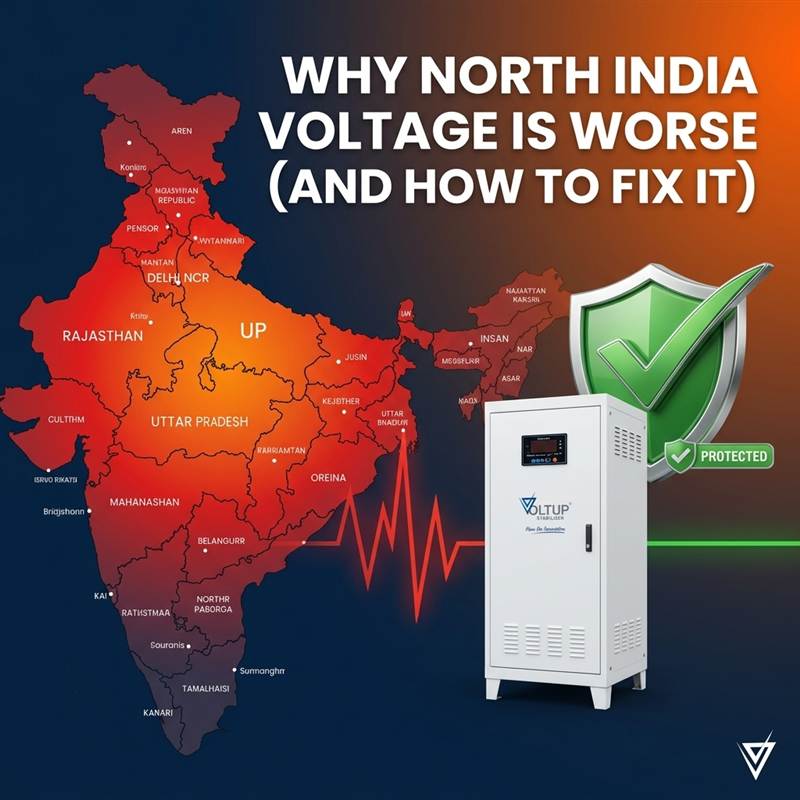
Key Takeaways (TL;DR)
- From UP to Rajasthan, power quality varies wildly. Here's a state-by-state breakdown and protection strategy.
- Protect Your Investment: Voltage stabilizers prevent silent damage to expensive PCBs and compressors.
- Expert Engineering: VoltUp products are ISO 9001:2015 certified and engineered for Indian power conditions.
If you live in Uttar Pradesh, Rajasthan, Bihar, Haryana, or the outskirts of Delhi NCR, you already know the pain: lights that dim every evening, ACs that struggle to start, and appliances that die before their time.
Voltage fluctuation isn't just an inconvenience in North India — it's a daily assault on every electrical appliance in your home. Here's why it happens, how bad it really is, and what you can do about it.
How Bad Are Voltage Fluctuations in North India?
India's standard household voltage is 230V (±10%), meaning the safe range is 207V–253V. But in many parts of North India, the reality looks very different:
🔴 Severe
Rural UP, Bihar, Jharkhand — common during peak summer
🟠 High Risk
Semi-urban Rajasthan, Haryana, MP — daily evening dips
🟡 Moderate
Delhi NCR outskirts, small cities — frequent but manageable
🟢 Safe Zone
Metro cores, areas near substations — generally stable
⚠️ In many North Indian towns, voltage regularly drops to 140–160V during summer evenings — far below what any "stabilizer-free" AC can handle.
5 Reasons North India Gets Hit Harder
1. Extreme Summer Demand Overloads the Grid
North India experiences some of the highest temperatures in the country — regularly exceeding 45°C in May and June. When millions of ACs, coolers, and fans switch on simultaneously during peak hours (6 PM–11 PM), the grid simply cannot keep up. The result? Voltage drops sharply across entire neighbourhoods.
2. Long Distribution Lines to Rural Areas
In rural UP, Bihar, and Rajasthan, homes can be 10–20 km from the nearest transformer. Every kilometre of wire adds resistance, which causes voltage drop. By the time electricity reaches the last house on a feeder line, it may have lost 30–50 volts.
3. Aging Infrastructure
Much of North India's power distribution network was built decades ago for a fraction of today's load. Old transformers, corroded wiring, and overloaded feeders create chronic instability that modern grid expansion hasn't fully addressed.
4. Unauthorized Connections and Power Theft
Illegal "kundi" connections are still common in many areas. These unmetered loads destabilise the local grid, causing erratic voltage swings that affect every legitimate consumer on the same feeder.
5. Rapid Urbanisation Outpacing Grid Upgrades
In Delhi NCR outskirts, Greater Noida, Lucknow suburbs, and Jaipur expansion zones, thousands of new homes and apartments are connected to grid infrastructure designed for a much smaller load. The result is chronic low voltage during peak hours.
State-by-State Breakdown
🏛️ Uttar Pradesh
Typical low: 130–170V in rural areasIndia's most populous state faces massive demand-supply gaps. Eastern UP (Varanasi, Gorakhpur, Allahabad) and rural western UP are worst affected. Summer brownouts are a daily reality.
🏜️ Rajasthan
Typical low: 150–180V in semi-urban areasExtreme heat (48°C+) drives enormous cooling demand. Long transmission lines across desert terrain cause significant voltage drop. Cities like Jodhpur, Bikaner, and rural Jaipur district face acute issues.
🌾 Bihar & Jharkhand
Typical low: 130–160V in rural areasInfrastructure gaps remain significant despite improvements. Rural electrification has expanded coverage but grid capacity hasn't kept pace. Patna outskirts and rural districts face severe fluctuations.
🏙️ Delhi NCR Outskirts
Typical low: 170–190V in new coloniesGreater Noida, Faridabad outskirts, Ghaziabad extensions — rapid construction creates pockets of grid stress. Older Gurgaon sectors also experience evening dips during peak AC usage months.
🌿 Haryana & Punjab
Typical low: 170–190V in agricultural beltsAgricultural pump loads create massive evening demand spikes. When tube wells start running during irrigation season, residential voltage drops noticeably across rural feeders.
🏔️ Madhya Pradesh
Typical low: 160–180V in tier-3 citiesGrowing industrialisation in Indore, Bhopal, and Gwalior corridors strains existing infrastructure. Smaller cities and towns face regular brownouts during summer.
What This Does to Your Appliances
Chronic low voltage doesn't just cause inconvenience — it causes real, measurable damage:
| Appliance | Effect of Low Voltage | Repair Cost |
|---|---|---|
| Inverter AC | Compressor overheats, PCB burns, reduced cooling | ₹8,000–₹25,000 |
| Refrigerator | Compressor struggles, food spoilage, motor burnout | ₹5,000–₹12,000 |
| Washing Machine | Motor overheats, spin cycle fails | ₹3,000–₹8,000 |
| LED TV | Power board damage, screen issues | ₹4,000–₹15,000 |
| Water Purifier (RO) | Pump failure, inconsistent purification | ₹2,000–₹5,000 |
A single summer without a stabilizer can cost more in repairs than 10 years of stabilizer protection.
The Protection Plan for North Indian Homes
Here's what every home in a voltage-affected area should do:
Step 1: Assess Your Voltage Level
Buy a simple digital multimeter (₹300–₹500) and check your voltage at 7 PM on a summer evening. If it drops below 180V, you need a stabilizer. Below 160V? You need a wide-range stabilizer (90V–300V input).
Step 2: Protect Your Big-Ticket Appliances First
Start with dedicated stabilizers for your AC and refrigerator — these are the most expensive to repair and most vulnerable to low voltage.
Step 3: Consider a Mainline Stabilizer
If your entire home experiences fluctuations, a mainline stabilizer (5–10 KVA) protects everything at once — ACs, fridge, washing machine, TV, and lights — from a single point.
Step 4: Choose the Right Specs
- Input range: 90V–300V — essential for extreme fluctuation zones
- 100% copper winding — handles heavy loads efficiently
- Servo motor type — smooth, precise correction
- Intelligent Time Delay — protects compressor during power cuts
VoltUp: Built for North India's Toughest Power
VoltUp stabilizers are specifically engineered for the extreme voltage conditions common across North India. With an ultra-wide 90V–300V input range, they keep working even when voltage drops to levels that would shut down most other stabilizers.
Need a Stabilizer?
VoltUp engineers are directly available to help you find the absolute perfect voltage stabilizer for your home appliances.
Contact Us Today